CFD simulation · Buildings
Natural ventilation for a parking garage
Smart opening design using CFD: the mechanical exhaust system is eliminated and energy use stays lower throughout the building's service life.
100%
Mechanical exhaust system eliminated
–$0
Ventilation operating cost over the building's service life
30–40%
Estimated reduction in energy use tied to the garage HVAC system
01Problem
A garage that did not meet the prescriptive criterion — and a long-term investment decision
The ES Metals parking project in California had a façade geometry that fell short of the 50% opening threshold on two or more sides required by Note 3 of Table 403.7 of the California Mechanical Code (CMC 2025) to be exempt from mechanical ventilation. The conventional path would have been a forced exhaust system with CO and NO₂ sensors, along with all the capital, operating and maintenance costs it carries over decades.
The client, however, saw a different opportunity: rather than accept the mechanical system as inevitable, they wanted to know whether the façade design —by adding flow-control structures (FINS)— could achieve natural ventilation performance equivalent to the prescriptive criterion, avoiding the system altogether.
02Solution
CFD simulation with OpenFOAM® to characterize current airflow and propose a FINS geometry
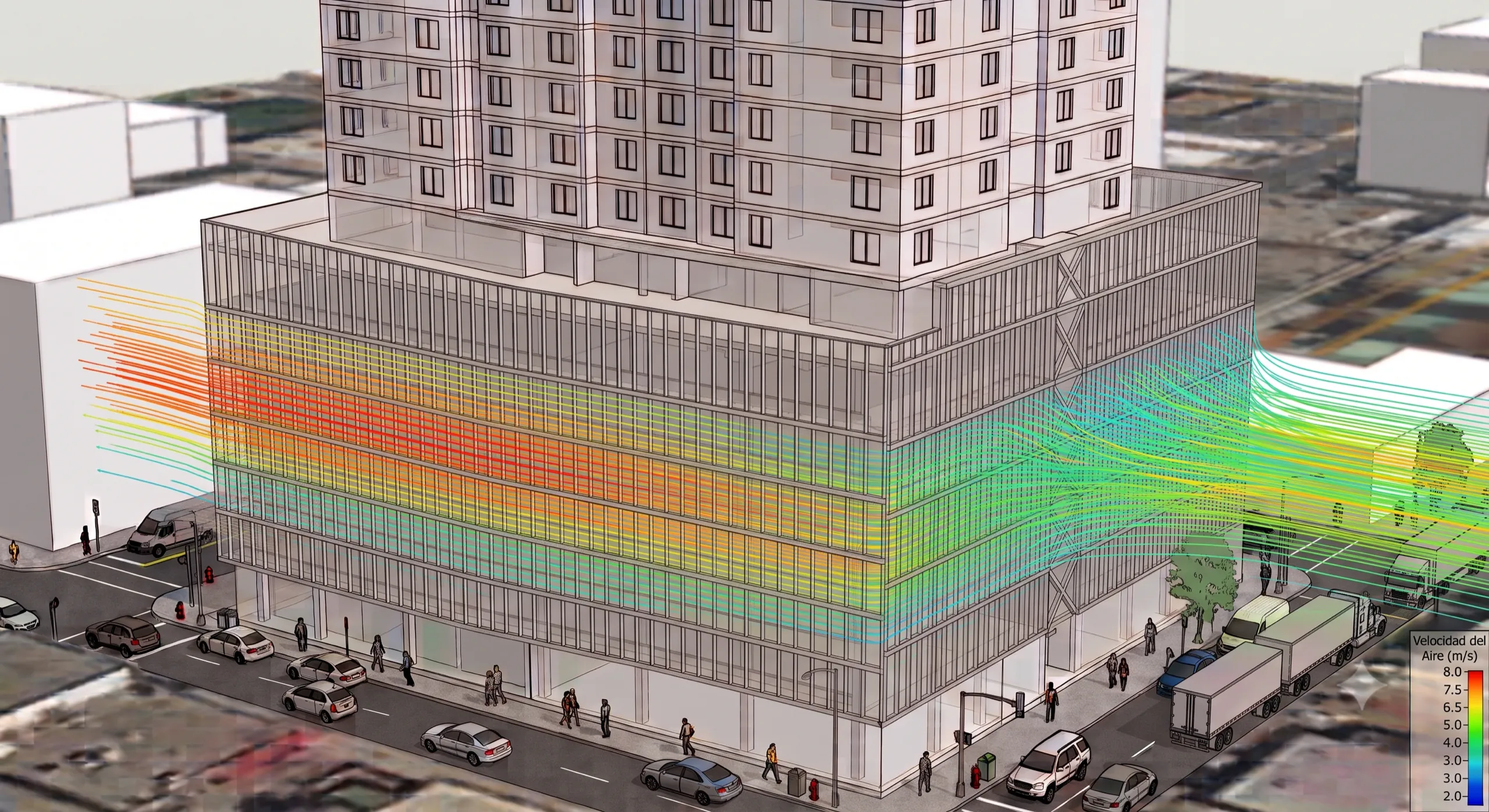
AxonID ran a full CFD simulation of the current (As Is) state of the garage level designated by the client. Using weather data from the ASOS station closest to the site, the team determined the prevailing wind direction and the worst-case condition for ventilation, which set the model's boundary conditions.
The computational mesh — up to 220 million elements, run on an HPC cluster — captured in high resolution the flow around and through the FINS, the velocity fields inside the garage, recirculation zones and areas of low air renewal. The results showed whether the proposed configuration produced flow patterns comparable to those of a garage with 50% free opening.
03Results
A system that works on its own — no energy, no maintenance, no failures
The simulation showed that the FINS layout and geometry produce velocity and air-renewal patterns consistent with the CMC 2025 reference criteria for naturally ventilated garages. The resulting technical information supports the justification to the authority having jurisdiction under the Alternative Engineering Design path (CMC Section 302.3).
The strategic benefit is direct: by eliminating the mechanical system, the client avoids an estimated initial capital outlay of $80,000 to $150,000 USD in exhaust equipment, ductwork and controls, and fully removes that system's recurring operating cost over the building's service life.
| Item | Mechanical system | Natural ventilation (FINS) |
|---|---|---|
| Initial investment | $80,000–$150,000 USD | $0 in mechanical equipment |
| Annual energy use | ~$8,000–$18,000 USD / year | $0 |
| Annual maintenance | $3,000–$8,000 USD / year | No system to maintain |
| Cumulative 25-year cost | $355,000–$650,000 USD | Practically zero |
| Operational failure risk | High (sensors, motors, controls) | Eliminated |
04Why it matters
Designing so no energy is needed is the smartest investment
Mechanical ventilation in garages is mandatory when the design cannot take advantage of natural wind movement. But every motor installed is a permanent commitment: it consumes energy every day, needs preventive and corrective maintenance, and fails. A well-designed garage —where the geometry itself moves the air— turns that perpetual cost into zero.
Using CFD as a design tool is not just a technical validation: it is a financial decision. Investing in simulation during design costs a fraction of the mechanical system it avoids, with a return that extends over decades. In long-lived projects such as parking structures, this difference is especially pronounced.
Technical sheet
Technical specifications
- Solver: OpenFOAM — steady-state, incompressible viscous flow (RANS)
- Mesh: up to 220 million elements, generated in ANSA® with refinement around the FINS
- Computing infrastructure: HPC cluster with parallel execution
- Weather conditions: hourly NOAA ASOS data from the designated station
- Variables analyzed: velocity field, pressure, vorticity, air renewal rates
- Code reference: CMC 2025, Table 403.7 Note 3 / Section 302.3 Alternative Engineering Design
- Team: PhD-level engineers in computational fluid dynamics
- Deliverables: configured CFD case, technical visualizations, section planes, report and executive presentation
Related services
Capabilities that complement this case
Combining capture, engineering, simulation, manufacturing and metrology makes it possible to control the entire workflow.
FEA / CFD simulation
Numerical modeling of flow, pressure, heat transfer and system behavior before you build.
BIM / Digital Construction
Building systems coordination and digital analysis of alternatives during project development.
BIM 360
Digital tracking, coordination and information management for architecture and civil engineering projects.
Do you have a similar technical challenge?
Share the files you have, the expected result and the project timeline. We will review the case and propose the right workflow.